Cotton Memories (Part One)
I don't think there's a single person in love with rock'n'roll who hasn't struggled, at least at some point in their life, to get rid of an accumulated pile of band tees. No matter that some can no longer be worn, those whose lives are shaped by the overdrive keep even the torn rags.
They shine under the magnifying glass of memory; these aren't just garments, they're cotton memories, reminding people of periods, people, events, and feelings.
I was one of those people. At one point, I had over 200 band and festival shirts in my closet. That completely insane number dropped sharply when, a little more than ten years ago, I handed several garbage bags full of shirts to a relative who was just entering the rock 'n' roll world. More than 100 shirts passed into the hands of someone I felt deserved to inherit what I'd built up.
As the years went by, it got easier to part with the fabric, but in some cases, letting go dragged on.
I say "process" because I see it, in a way, as a parallel to the Kübler-Ross stages of grief.
First, I notice the shirt is worn out.
Then I deny it's time to throw it away.
Then I stall and tell myself it can survive a little longer.
Then I get angry: at myself for denying and stalling, for not being able to throw it out, and at the shirt for falling apart.
The fifth stage is the final one. I accept that it's time to let the shirt go.
If the shirt is still in decent shape, I fold it up and donate it.
If it isn't, I throw it away.
But regardless of whether it's in good shape or a rag, if it means a lot to me, I go through a farewell ritual, a closure.
I put it on one last time, remember everything we went through together, then take it off and tear it apart so no one else will ever wear it.
Usually, the shirts I tear are so old the cotton splits like paper, and little clouds of dust fly off in every direction.
This series of texts will be a kind of remembrance and tribute to all those beloved shirts, where and how I got them, and what they meant to me.
Inepsy (Canada)
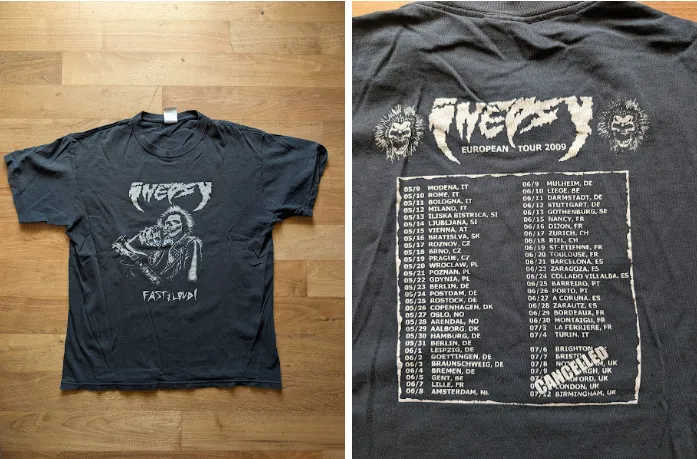
I don't know which day of the tour it was for Rapa Nui and Motherpig in May 2009, but on the 17th, we arrived in Rožnov, Czech Republic, where a local squat gave us the chance to play with Inepsy from Canada. I would only later come to fully appreciate the band's musical stature, but what kind of people they were became clear that very night.
After the show, the organizer gave our bands 16 euros. Yes, two bands got 8 euros each. Inepsy got 200 euros. When Inepsy heard what had happened, they came over and handed us 100. "We split fairly, the organizer is an asshole. This is punk," said Sam, the bleach-blond drummer. When we protested and asked them not to do it, guitarist Chany and Sam said "No way," and that it was the only right thing to do.
We tried again to talk them out of it, and Sam threatened us with physical violence (I'm not sure whether he was joking or not; it didn't seem like he was) if we didn't take the money.
We returned the favor by spending half of it on beer, which we all drank together. This shirt is a memento from that show, and no shirt has ever been harder to throw away. It couldn't be washed anymore and was cracking apart at the seams and everywhere in between.
Inepsy hasn't existed for years, but in 2025, the American label Tankcrimes reissued their albums on digital and vinyl. Essential listening for every Motörhead and Discharge fan... Inepsy are perfect!
Undercover Motherfucker (Županja)
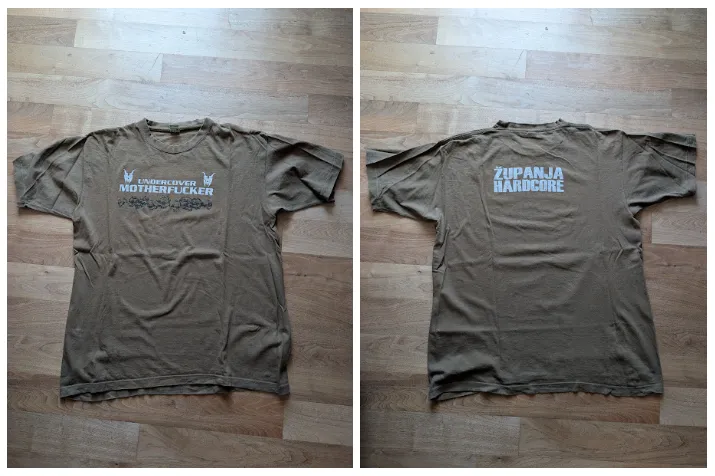
It was April 2007, and a show was organized in Sarajevo featuring two bands from Županja: Undercover Motherfucker and Infernal Hemeroid. My memories of that night are murky, almost nonexistent, but as far as I know, it was the first, or at least one of the first, times Sarajevans met the crew from Županja. Over the next 20 years, the Županja crew established itself as one of the most consistent and productive hardcore punk collectives in the entire post-Yugoslav space, with all their organizational endeavors culminating in SAWA Fest.
What made this show matter most to me is that it was my first encounter with Atlija, today active in the band Vipera, who was playing in Infernal Hemeroid at the time. Two years later, he joined Motherpig and helped me achieve some of my greatest moments as a non-professional musician. Motherpig is gone, but the friendship and the tonnes of memories remain.
I went home from that show with three shirts: the van driver gave me a black one that read "Anarchy: don't know what it means, but it sounds good"; there was the Infernal Hemeroid shirt; and this Undercover Motherfucker one. The Infernal shirt lasted the shortest, the Anarchy one held on a bit longer, but the Undercover Motherfucker survived all the way to May 2025, until the cotton lost its ability to hold a smell after washing.
KRV (Sarajevo)
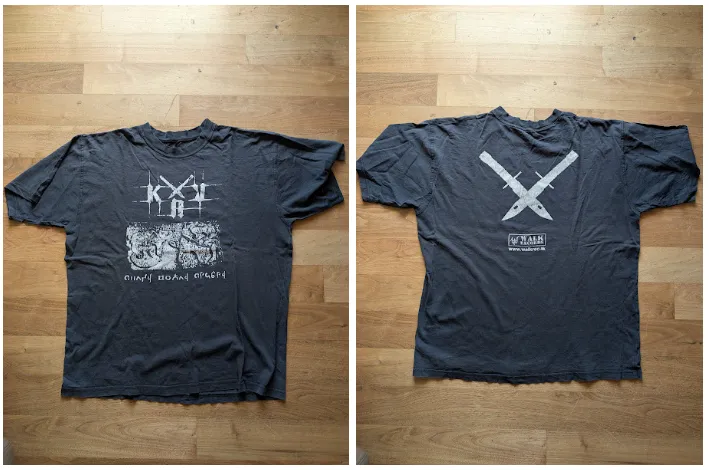
Although I'd heard black metal before, Sarajevo's KRV taught me how to actually listen to black metal. This shirt is a relic from an older era, when the metal scene existed on forums like Rock Planet and was, in its own way, healthier than the one today.
On the back of the shirt is the Walk Records logo, a label from Doboj. Mića and his brother helped an entire generation of bands release their albums in physical format. Recently, on the occasion of the 20th anniversary of the mini-album Silna volja srebra, KRV found the old print file for this shirt and released a new batch of old shirts, which made it a little easier to part with this particular memory.
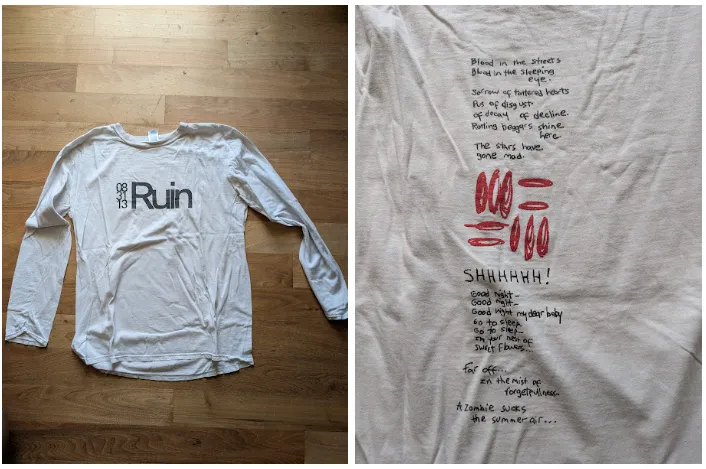
Ruin (Philadelphia)
In 2019, I was working as a journalist at the magazine Dani. During that time, I discovered the Philadelphia hardcore punk band Ruin, which was basically rooted in Buddhist philosophy. Interested in both subjects, I got in touch with Glenn Wallis, co-founder of the band, and we did an interview that became episode 17 of the podcast Radijo; a shorter version was published in Dani magazine in October 2019.
After that conversation, a massive package showed up at my door. Wallis had packed his excellent, but at the time hard-to-digest, book, A Critique of Western Buddhism: Ruins of the Buddhist Real, along with shirts for my whole family. It was an unexpected and wonderful gift, one that reminded me of the time I spent at Oslobođenje, the parent company of Dani (because there are too many bad memories from that period otherwise).
This shirt didn't wear out as much as the others, but after the pandemic, I gained 5 kilograms that I never lost again, and it became too small, so it was time to say goodbye.
TO BE CONTINUED…
This is a translated and lightly edited version of an article originally written and published in Bosnian by yours truly at onajkojikuca.com.
Thank you for reading. You can reach me via e-mail or My Mastodon profile.
Alternatively, subscribe via RSS feed.
Or, or... You can share your address with me if I decide to start a newsletter one day, and you'd like to receive it occasionally in your inbox. I won't spam or share your email with anyone, I promise!
Sharing this would be cool, too. Once again, thank you.